

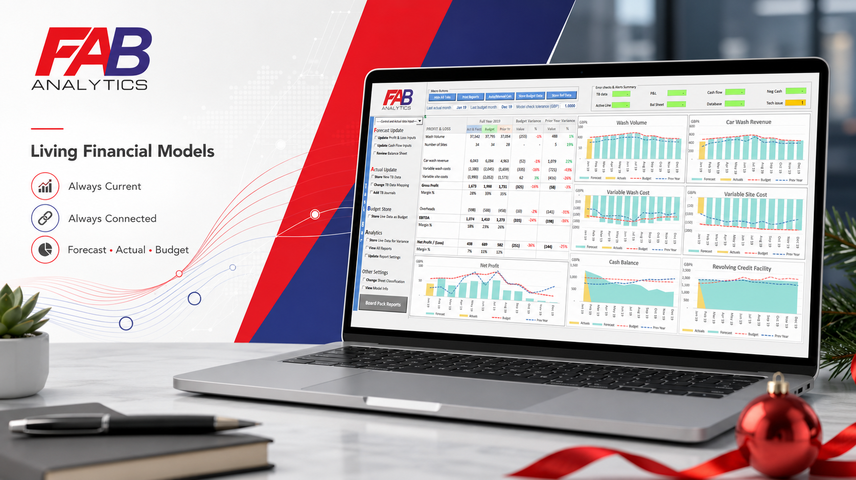
Most financial models are built for a single event. As my mentor, Kevin Gate, often said, “Models are not for Christmas, they are for a lifetime.” The best models become living systems that connect forecast, actuals and budget over time.
For CFOs, the issue is rarely a lack of models. It is a lack of continuity. A model that supports a fundraising round, board decision or lender request should not disappear once the transaction is complete. It should become part of the company’s operating rhythm.
The Problem: Models Are Built for Moments, Not Businesses
Many financial models are created under pressure: a fundraising round, board meeting, lender request, acquisition, valuation or annual budget cycle.
They are reviewed intensely for a few weeks, used to support a major decision, and then slowly abandoned.
Six months later, the same company often has a new budget file, a separate actuals report, a different board pack, a management dashboard built somewhere else, and a forecast that no longer ties cleanly to the transaction model.
The business has moved on. The model has not.
That is the core weakness in traditional financial modelling. A serious financial model should not be a one-off transaction file. It should evolve from deal model to operating plan, to budget, to forecast, to actuals bridge, to board reporting pack.
The CFO’s Real Problem: Model Fragmentation
Most CFOs do not suffer from having too few Excel files. They suffer from having too many disconnected ones.
- One file for the board.
- Another for the bank.
- Another for the budget.
- Another for actuals.
- Another for headcount, revenue and management reporting.
The result is not merely inconvenience. It creates decision risk.
The Association for Financial Professionals’ 2025 FP&A Benchmarking Survey found that 61% of respondents said lack of reliable data was a challenge, while 60% cited lack of access to data. More than half reported using at least eight categories and ten types of reporting tools on a quarterly basis.
That is the modern CFO’s reality: finance teams have more tools than ever, but not necessarily more trust.
Why One-Off Models Die
A one-off model usually dies for six reasons:
- The model is too investor-focused and not management-focused.
- It is built around the transaction, not the operating rhythm of the business.
- It does not allow forecast, actual, and budget data to be maintained together without one version overwriting another.
- It does not have a clean mapping between accounting data and management forecast lines.
- It does not integrate non-financial drivers such as headcount, sales pipeline, customer metrics, production volumes, churn, occupancy, pricing or utilisation.
- It is not designed to produce recurring management outputs.
That is why a model can be technically impressive and commercially useless six months later.
The FAB View: A Model Should Live Through Forecast, Actual and Budget
The FAB philosophy is simple. A good financial model should continuously connect three views of performance:
- Forecast — what management expects to happen.
- Actual — what has happened in the accounts.
- Budget — what the organisation committed to deliver.
This is not just a reporting structure. It is a discipline.
A FAB model allows the CFO, board, investor, lender or management team to ask better questions:
- Why did actual gross margin move away from budget?
- Was the variance due to price, volume, mix, timing or cost inflation?
- Should the forecast change because of this variance?
- Are the assumptions approved during the transaction still valid?
- Is the company still on track for its debt covenants, equity story, valuation target or exit plan?
That is where the model becomes valuable after the deal.
The Board Does Not Need More Numbers. It Needs Continuity.
Senior decision-makers do not want another beautiful spreadsheet. They want continuity of logic.
They want to know that the assumptions used to approve the investment are the same assumptions being monitored after the investment.
They want to see how actuals compare to budget and how the latest forecast changes the future.
They want one version of commercial truth.
That is what FAB is designed to provide: it turns the model from a static file into the financial operating system of the business.
The Strongest Models Are Built for the Next Question
A weak model answers only the question it was originally built for. A strong model is ready for the next question.
For example:
- What if revenue is delayed by three months?
- What if hiring is slower than planned?
- What if interest rates stay higher?
- What if the customer mix changes?
- What if the actual margin trend is different from the investment case?
- What if the exit happens one year later?
The ability to answer these questions quickly is becoming more important. Gartner found that only 15% of FP&A leaders reported having a sustainable delivery model capable of consistently supporting decision-makers without burning out staff.
That is precisely why finance leaders need models that live with the business, not models that are rebuilt every time a new question arrives.
Final Thought
A financial model should not be treated like a Christmas decoration: taken out for a special event, admired briefly, and then packed away.
For a CFO, investor or board, the model should be a living system of financial memory, commercial logic and decision support.
That is the promise of FAB.
The model you use to approve the investment should be the same model you use to monitor, reforecast, report and exit.
Written by:
Yatin Sehgal
Founder & CEO