

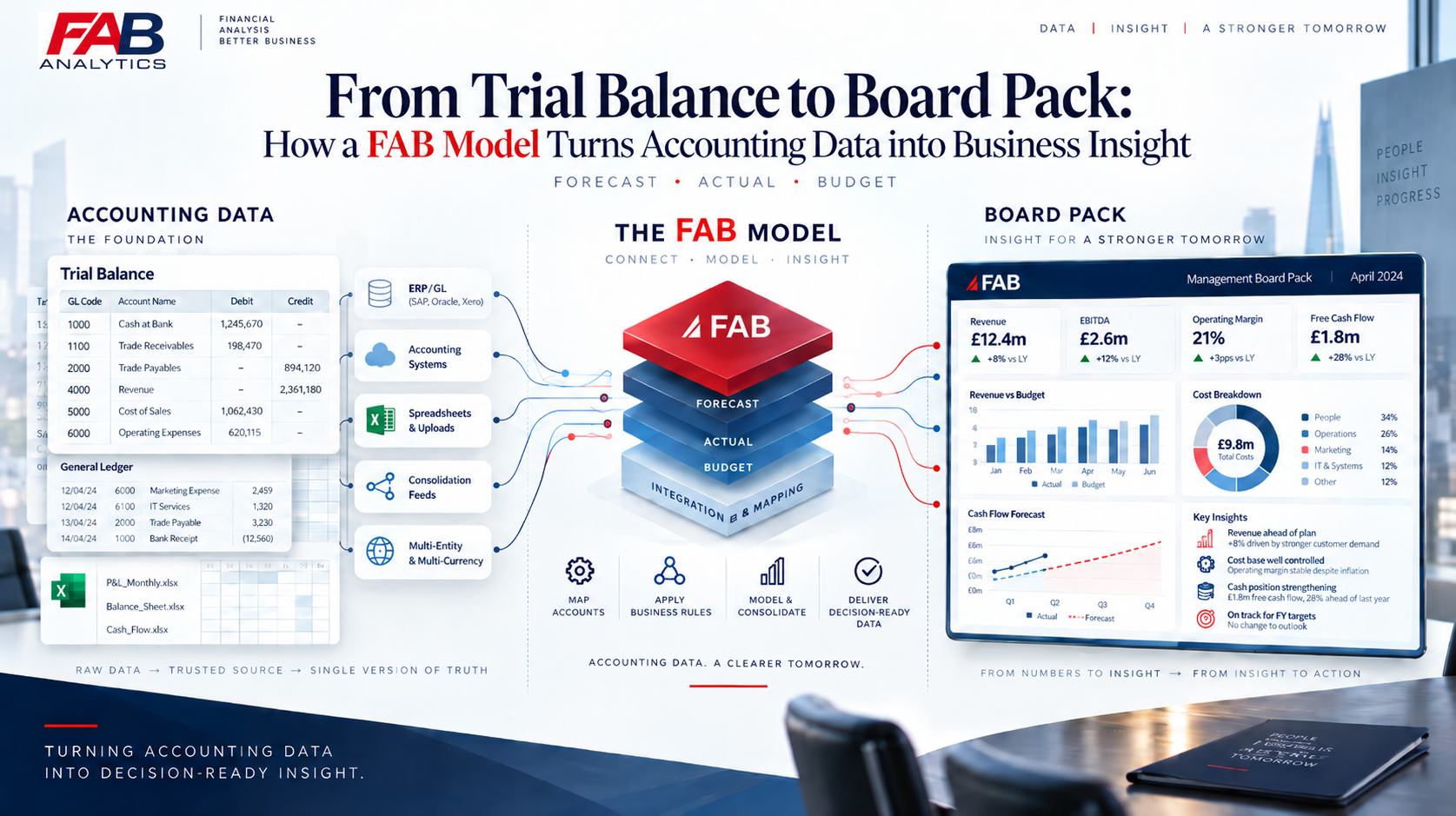
Accounting data tells you what happened. A FAB model explains what it means.
Every business has accounting data. But not every business can turn that data into insight. A trial balance can tell the CFO where costs were booked. It does not automatically explain whether the business is on track.
A general ledger can show actual revenue. It does not explain whether the variance came from volume, price, timing, mix, churn, occupancy, utilisation or contract delays.
A management report can show EBITDA. It does not always explain how that EBITDA affects cash, debt capacity, covenant headroom, valuation or future funding needs.
This is the gap between accounting and decision support. FAB exists to close that gap.
The traditional problem: accounting structure is not management structure
Accounting data is usually built around compliance, statutory reporting and bookkeeping. Management needs a different lens. The board wants to see business lines, products, regions, customers, projects, cost centres, operational KPIs, cash conversion and forward-looking performance.
That means the CFO must convert accounting information into management information. In many companies, this conversion is manual. Finance exports the trial balance, adjusts rows, maps accounts, creates management lines, updates formulas, reconciles numbers, prepares commentary and builds a board pack. Then the cycle repeats next month. That process is slow, risky and difficult to scale.
FAB creates a structured bridge
A FAB model turns the trial balance into a reporting financial tool through a disciplined process.
- Accounting data is imported.
- General ledger codes are mapped into active reporting lines.
- Management information is added: HR, sales, operational, commercial and industry-specific drivers.
- The accounting view is converted into an integrated P&L, balance sheet and cash flow.
- Actuals are blended with forecast and budget.
- Board-level outputs are generated from the model rather than manually rebuilt.
This is where accounting data becomes business insight.
Why this matters now
The need for speed is increasing. The FP&A Trends Survey 2024 found that 53% of organisations take more than five days to produce a forecast, while only 22% can run scenarios in real time or within one day. That is a major issue for CFOs operating especially in uncertain markets.
When interest rates, demand, pricing, supply chains, hiring plans, working capital and funding conditions are moving quickly, decision-makers cannot wait for slow manual reporting cycles. The board pack must become more dynamic.
A better board pack starts with a better model
Many companies try to improve board reporting by redesigning slides. But the real improvement comes from redesigning the model beneath the slides. A strong FAB model allows the board pack to answer:
- What changed versus budget?
- What changed versus prior forecast?
- What changed versus the original investment case?
- Which driver caused the change?
- What is the impact of every change on 3 financial statements?
- When will the business run out of cash?
- When to start preparing the next fundraise?
- What is the impact on valuation?
This is not cosmetic reporting. It is decision-grade reporting.
FAB makes variance analysis meaningful
Traditional variance analysis often stops at line items. Revenue is up. Payroll is down. Marketing is over budget. EBITDA is behind plan. That is not enough.
A senior board needs driver-based variance analysis.
- Revenue is up because pricing offset lower volume.
- Payroll is below budget because hiring is delayed, but contractor costs are rising.
- Marketing is over budget because customer acquisition costs increased in one channel.
- EBITDA is behind plan because gross margin compression is not being offset by operating leverage.
FAB connects the accounting numbers to commercial drivers so that variance analysis becomes useful.
The model becomes a management tool
The real power of FAB is that it supports a recurring tool.
- Monthly actuals are imported.
- Mapping updates are controlled.
- Budget is created in the model or imported from other sources
- Forecast assumptions are refreshed.
- Budget variances are analysed.
- Cash flow impact is reviewed.
- Board outputs are generated.
- Management decisions are taken using the model.
Over time, the model becomes the company’s financial memory. It shows not only what the company believed at the start of the year, but how that belief changed as reality unfolded.
The investor and lender angle
For investors and lenders, this is particularly valuable. A transaction model often contains the original business case. But after the transaction closes, the model is frequently abandoned and replaced with separate reporting packs. That breaks continuity.
A FAB model keeps the original investment logic alive. It allows investors, lenders and management teams to compare the actual business against the underwriting case, the approved budget and the latest forecast.
For private equity portfolio monitoring, credit reporting, real estate development, and infrastructure projects, that continuity is powerful.
Final thought
The trial balance is not the destination. It is the starting point. The real question is whether finance can convert accounting data into insight fast enough for senior decision-making. FAB provides the structure to do that. It turns the finance model into a bridge between accounting, operations, forecasting, budgeting and board-level action.
From trial balance to board pack, FAB turns numbers into decisions.
Written by:
Yatin Sehgal
Founder & CEO