

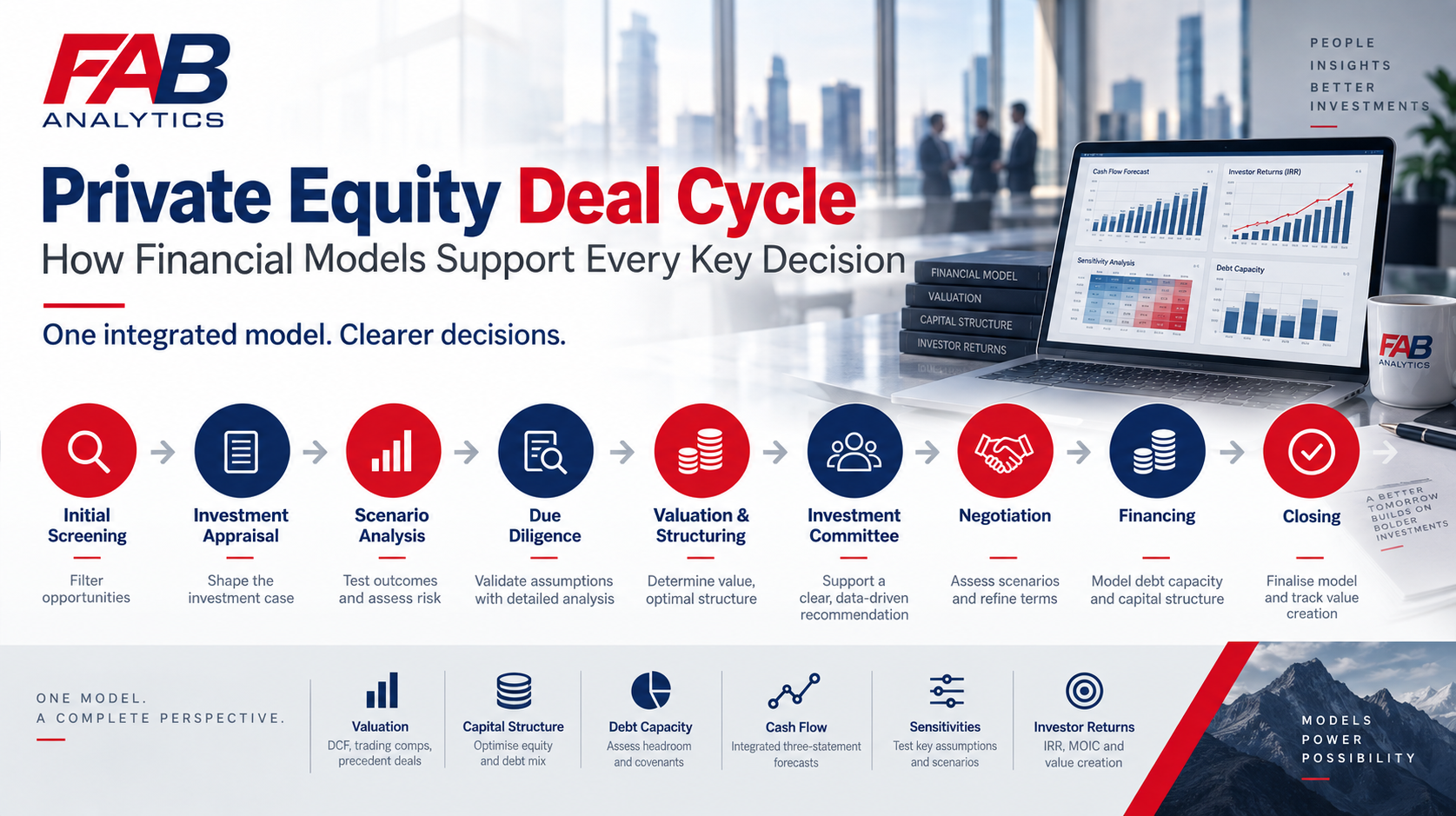
A private equity transaction involves far more than simply calculating an expected IRR or applying an entry and exit multiple. The financial model sits at the centre of the investment appraisal process because it brings together the operating case, valuation, capital structure, debt capacity, cash flows, sensitivities and investor returns within one integrated framework.
For a serious transaction, especially where a professional financial modelling firm is engaged, the goal is usually not to build a series of disconnected spreadsheets at each stage of the process. A well-designed investment model is built early, incorporates multiple scenario options, and is gradually refined as new information becomes available through diligence, financing discussions and negotiations.
The role of the model therefore changes as the PE deal progresses. At first the financial model tests whether the opportunity is worth pursuing. Later the model helps validate the investment thesis, assess downside risk, structure the transaction, support Investment Committee decisions, evaluate negotiation points and establish the final economics of the deal.
1. Initial Screening: Is the Opportunity Worth Deeper Analysis?
At the earliest stage, the investment team normally needs to determine whether the opportunity fits the fund’s investment criteria and whether it merits further time and diligence.
The financial analysis at this point may still be relatively high level. The team may test headline valuation, expected growth, profitability, funding requirements, leverage potential and indicative investor returns.
The purpose is not to produce the final transaction model immediately. It is to establish whether the opportunity can plausibly generate acceptable returns under a reasonable set of assumptions.
If the opportunity passes this initial screen, the modelling work can then become substantially more detailed.
2. Investment Appraisal: Building the Core Deal Model
Once an opportunity moves into formal investment appraisal, the financial model becomes the central quantitative framework for the transaction.
A professionally built PE investment model would typically contain the operating forecast, transaction assumptions, acquisition funding, debt schedules, cash flows, valuation, exit analysis, IRR, MOIC and scenario functionality within a single integrated model.
Importantly, the forecasting methodology should reflect the maturity and information profile of the target company.
Early-Stage and High-Growth Businesses
For early-stage or rapidly scaling businesses, historical financial information may be too limited to justify the future scale assumed in the investment case.
The model therefore often needs to rely more heavily on market evidence, external benchmarking and commercial assumptions. This may include total addressable market, expected market growth, comparable-company metrics, customer acquisition, penetration rates, pricing, unit economics, capacity and benchmark margins at scale.
In these situations, the modelling challenge is not simply to extrapolate the company’s limited history. It is to test whether the future operating scale required to achieve the investment case is credible relative to the market opportunity.
For example, if the investment thesis assumes that revenue will increase several times over the investment period, the model should help the deal team understand what market share, customer growth, pricing, capacity or operating assumptions would be required to support that outcome.
Established Businesses with Meaningful Operating History
For established businesses with a reliable operating history, a more granular driver-based forecast is often appropriate. Rather than forecasting revenue and costs using broad percentage assumptions, the model can link financial performance to the underlying business drivers.
Depending on the business, these may include volumes, pricing, customer numbers, churn, locations, occupancy, production capacity, utilisation, headcount, sales conversion, gross margins, working-capital days and capital expenditure requirements.
This allows the investment team to understand not only what the forecast says, but what needs to happen operationally for that forecast to be achieved.
3. Scenario Analysis: One Model, Different Investment Outcomes
Private equity investment appraisal rarely depends on a single forecast case. The same integrated model should normally allow the deal team to move between different assumptions and transaction outcomes without creating multiple disconnected models.
Typical scenarios may include a management case, investment case, upside case and downside case. The model may also allow the user to test different acquisition prices, financing structures, leverage levels, interest rates, operating assumptions, exit years and exit multiples.
This is particularly important because the attractiveness of a transaction can change materially when several assumptions move together. For example, slower revenue growth combined with lower margins and a lower exit multiple may have a substantially greater impact than testing each variable independently.
A strong scenario framework therefore gives the investment team a controlled way to understand both the upside opportunity and the downside protection within the same model.
4. Due Diligence: Updating the Model as Evidence Improves
The initial investment model is built using the best information available at the time. Due diligence then provides the evidence needed to challenge and refine those assumptions.
Financial diligence may identify normalisation adjustments to EBITDA, working capital or cash flows. Commercial diligence may revise assumptions around market size, pricing, customer retention or growth. Operational diligence may identify capacity constraints, additional headcount or capital expenditure requirements. Tax, legal and financing workstreams can also affect the cash flows and structure of the transaction.
The value of an integrated model is that these findings can be translated directly into their financial consequences. Instead of asking only whether a diligence issue exists, the investment team can ask what it means for valuation, leverage, cash generation and investor returns.
For example: if sustainable EBITDA is lower than management’s presentation, how much does the investment return change? If additional capital expenditure is required, how does it affect debt repayment? If growth is delayed, is the investment still capable of meeting the fund’s return threshold?
The model therefore acts as the bridge between due-diligence findings and the investment decision.
5. Valuation & Deal Structuring: Testing the Deal Economics
As the deal advances, the financial model becomes increasingly important in determining how the transaction should be structured.
The investment team can test different combinations of entry valuation, debt and equity funding, interest rates, amortisation, repayment profiles, shareholder instruments and exit assumptions.
This helps answer questions such as:
- What is the maximum entry valuation that still produces an acceptable return?
- How much leverage can the business support without creating unacceptable downside risk?
- How sensitive are returns to interest rates and debt repayment?
- Does the transaction require further equity during the holding period?
- How much of the return comes from operational growth, deleveraging or changes in valuation multiple?
- What happens to returns if the exit is delayed?
At this stage, the model is not simply forecasting the company. It is helping the investment team optimise the economics and risk profile of the transaction.
6. Investment Committee: Making the Investment Thesis Transparent
By the time the transaction reaches Investment Committee, the model should represent the most current and internally consistent version of the investment case.
The objective is not merely to present a headline IRR or MOIC. Decision-makers need to understand how those returns are generated and which assumptions are most important.
A well-structured model should allow the Investment Committee to assess questions such as:
- What level of revenue and EBITDA growth is assumed?
- How much margin improvement is required?
- How dependent are returns on leverage?
- Is multiple expansion assumed, or can the target return be achieved without it?
- What is the downside case?
- How much liquidity and covenant headroom exists?
- Which assumptions have the greatest impact on IRR and MOIC?
- What happens if the exit takes longer than expected?
The best investment models make the return mechanics visible. Transparency is particularly important because a sophisticated model that cannot be clearly understood by senior decision-makers provides limited value.
7. Negotiation and Final Deal Terms: Quantifying the Impact of Changes
Transaction terms often continue to change after the core investment case has been developed. The purchase price may move. Financing terms may change. Additional debt may become available. Management rollover, earn-outs, transaction fees or other commercial terms may be negotiated.
Because the model already contains the transaction architecture, the investment team can quantify the impact of these changes quickly and consistently. For example, the team can assess whether a higher purchase price can be offset by better financing terms, whether an earn-out changes the effective entry valuation, or whether revised debt terms materially affect cash generation and investor returns.
The model therefore becomes an important negotiation tool because it allows the investment team to understand the economic consequence of proposed changes before agreeing to them.
8. Financing and Lender Analysis: Ensuring the Capital Structure Works
Where leverage forms part of the transaction, the model also supports discussions with lenders and debt advisers.
The transaction model can incorporate debt quantum, interest rates, repayment schedules, mandatory amortisation, cash sweeps, covenant calculations and refinancing assumptions.
This allows the deal team to test not just whether leverage improves equity returns, but whether the business can realistically service that debt under different operating scenarios.
A downside case is particularly important here. The appropriate capital structure is not simply the one that maximises the base-case IRR; it must also remain workable if the business performs below expectations.
9. Signing and Closing: Establishing the Final Transaction Economics
Immediately before signing and closing, the financial model should reflect the final commercial and financing terms of the transaction.
This may include the agreed purchase price, final debt package, transaction fees, management investment, shareholder instruments and any other material sources and uses.
The model provides the investment team with a final view of the expected returns based on the terms actually being executed rather than the assumptions used earlier in the process.
In this sense, the completed transaction model becomes the financial record of the investment case approved and executed at closing.
Conclusion
The role of a financial model in private equity is not limited to producing an IRR calculation at the end of the appraisal process.
A properly structured investment model can support the transaction from the point at which the opportunity becomes serious through to final closing.
As the deal progresses, the model evolves with the information available:
Initial Screening → Investment Appraisal → Scenario Analysis → Due Diligence → Valuation & Structuring → Investment Committee → Negotiation → Financing → Closing
For early-stage businesses, that analysis may rely heavily on market data and benchmarking to support the scale of the future opportunity. For established businesses, it may be driven by detailed operating assumptions grounded in historical performance.
In both cases, the strongest approach is usually to maintain one integrated model with controlled scenario functionality and refine it as the transaction evolves.
That provides the investment team with a consistent financial framework for testing the thesis, understanding risk, making decisions and ultimately agreeing the economics of the transaction.
At FAB Analytics, we support private equity investors with transaction-focused financial models designed to make assumptions, deal structure, scenarios and investor returns transparent throughout the investment appraisal process.
Written by:
Palak Mittal