

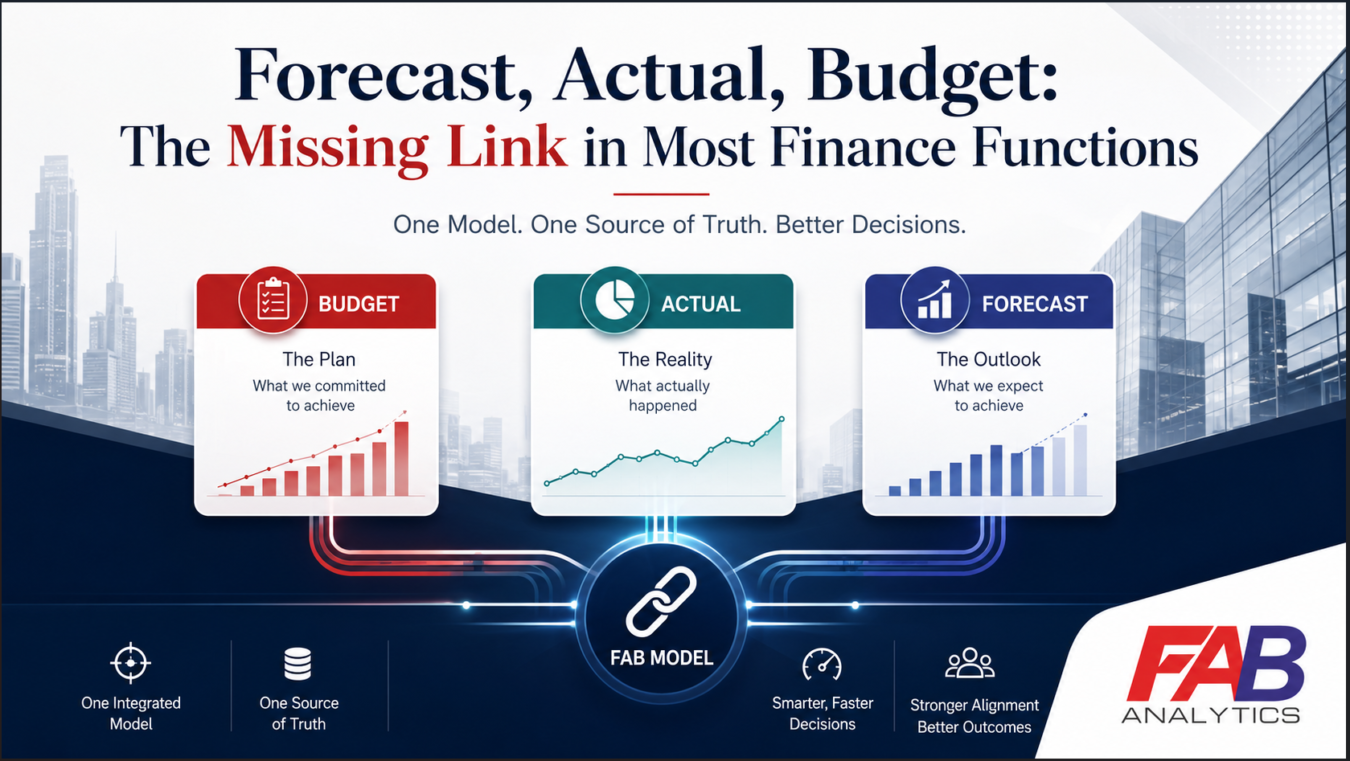
Finance has the right ingredients – but they are often in the wrong places
Most finance functions already produce forecasts, actuals and budgets.
The problem is that they usually sit in different files, different systems, different formats and different conversations.
• The forecast is owned by FP&A.
• The actuals come from accounting.
• The budget may have been prepared months ago.
• Operational drivers sit with sales, HR, operations or commercial teams.
• The board pack is built manually on top of all of it.
The result is a finance function that works hard but moves slowly.
The company may technically have the numbers. But it does not have an integrated decision system.
That is the missing link FAB is designed to solve.
Why the gap matters
When forecast, actual and budget are disconnected, the CFO loses time in reconciliation instead of analysis.
Teams spend hours asking basic questions:
• Which version is correct?
• Why does the budget not match the board pack?
• Why does the forecast not tie to the accounting actuals?
• Why does revenue in the management report differ from revenue in the model?
• Which cost line should this GL account map to?
• Are we comparing like-for-like?
This is not a junior analyst problem. It is a leadership problem.
If the finance function cannot quickly connect what was planned, what happened, and what is now expected, management decision-making becomes slower and less reliable.
The data supports the pain
The 2025 AFP FP&A Benchmarking Survey found that lack of data reliability and accessibility were the biggest barriers to FP&A technology success. It also found that spreadsheets remain heavily used, with 96% of respondents using them for planning and 93% using them for reporting on a daily or weekly basis.
This is important because it cuts through the myth that finance problems are only caused by Excel.
The real problem is not the tool. It is the absence of an integrated model architecture.
FAB creates one connected finance language
FAB stands for Forecast – Actual – Budget.
It is built around a simple principle: finance should not treat planning, accounting and reporting as separate worlds.
A FAB model creates a bridge between them.
• The trial balance is imported.
• Accounting codes are mapped into active reporting lines.
• Management information is added.
• Commercial and operational drivers are linked.
• Historical P&L, balance sheet, and cash flow financials are linked to business drivers to create a dynamic, driver-based forecast model.
• Actuals are compared against budget and forecast.
• The model remains alive for reporting, reforecasting and board-level decisions.
This allows the CFO to move from explaining numbers to explaining performance.
The CFO conversation changes
Without FAB, the conversation often sounds like this:
• “We need to check the file.”
• “That number is from the old version.”
• “Actuals are not updated yet.”
• “The budget file has a different structure.”
• “We need a few days to reconcile this.”
With FAB, the conversation becomes more useful:
• “Revenue is below budget because volume is behind plan, but price is ahead.”
• “Gross margin pressure is coming from input cost inflation, not discounting.”
• “Headcount is below budget, but contractor spend is offsetting the saving.”
• “Cash is tighter because receivables days are moving against plan.”
• “The latest forecast shows covenant headroom reducing in Q3.”
That is the difference between reporting and insight.
Why this matters for boards and investors
Boards and investors do not want more finance packs. They want sharper explanations of business performance.
They want to understand:
• What changed?
• Why did it change?
• What does it mean for the future?
• What action is required?
A FAB model supports this by connecting past performance with future expectations.
It allows management to explain not only what happened, but whether the business thesis still holds.
For private equity, credit funds, family offices and growth companies, this is particularly valuable. The investment case should not disappear after closing. It should become the monitoring framework.
The annual budget is not enough anymore
The FP&A Trends Survey 2024 found that 63% of respondents were comfortable forecasting less than six months ahead, including 39% who were comfortable forecasting less than three months ahead. Yet 57% of organisations still took one to three months to prepare an annual budget, while around a quarter took three to six months.
That mismatch is critical.
Businesses need faster and more regular forecasts, but many finance teams are still working with slow annual budgeting processes.
FAB helps close that gap by bringing forecasts, actual results and budgets into one continuous model, so management can update expectations, compare performance and make decisions more quickly.
Final thought
Forecasts, actuals and budgets are not separate finance exercises.
They are three views of the same business.
When they are disconnected, finance becomes a reconciliation function.
When they are integrated, finance becomes a decision engine.
That is why FAB is not just a modelling method. It is a better way for CFOs to run financial decision-making.
Sources:
2025 AFP FP&A Benchmarking Survey Report: Technology & Data
The 2024 FP&A Trends Survey Results: Key Insights and Findings Unveiled | FP&A Trends
Written by:
Yatin Sehgal
Founder & CEO